


02 Sep NON TAM VANA COEGIT GLORIA QUAM ROME VETEREM RENOVARE DECOREM.


Sant’Urbano alla Caffarella, the House of Crescenzi and Rome around the Year 1000
The church of Sant’Urbano alla Caffarella is one of the most evocative examples of continuity between ancient Roman architecture and the Middle Ages. The building largely preserves the structure of an ancient Roman temple, built in the 2nd century AD on land belonging to Herodes Atticus and dedicated to the memory of his wife, Annia Regilla, and to deities of the Roman pantheon, including Ceres and the deified Faustina. In the 9th century, the temple was converted into a Christian oratory and later dedicated to Pope Urban.
Its secluded location in the Caffarella Valley probably contributed to the preservation of this remarkable ancient structure. Inside, the cella was decorated with a cycle of medieval frescoes depicting scenes from the life of Christ and figures of Saint Lawrence, Saint Urban and Saint Cecilia, providing an important testimony to medieval Roman painting. The building was subsequently extensively restored in 1634 at the request of Pope Urban VIII Barberini.
A, in some respects, parallel example of this relationship between antiquity and the Middle Ages is the House of Crescenzi, in the Rione Ripa, opposite the Temple of Portunus. Built between the 11th and 12th centuries, it is a rare surviving example of a post-antique aristocratic residence in Rome. The urban setting in which it now stands is very different from its original surroundings: in the 1930s, much of the area between the Theatre of Marcellus and the Bocca della Verità was demolished to make way for new roads and urban development.
The façade of the House of Crescenzi reveals the particular relationship that medieval Roman aristocratic culture had with the legacy of antiquity. The building incorporates numerous Roman architectural elements, including volutes, coffers, cornices, fragments of entablature and other reused materials. Their use was not merely decorative: the visible reference to the grandeur of ancient Rome helped enhance the prestige of the family and its residence.
Particularly significant is the inscription running along the façade, in which the patron declares that he built the house not “out of vanity, but to restore the ancient splendour of Rome.” The phrase effectively expresses the desire to reclaim Rome’s memory and identity that characterized part of the aristocratic culture of 11th- and 12th-century Rome. The house was built by Nicola, son of Crescenzio and Teodora, for his son Davide, in a strategic position for controlling traffic along the Tiber and across the Aemilius Bridge, now known as Ponte Rotto.
This revival of the ancient past forms part of the complex political and cultural landscape of Rome around the year 1000. During the 10th and 11th centuries, the city was marked by intense competition among the papacy, the Roman aristocracy and imperial authorities, while the Ottonian tradition of the Renovatio Imperii strengthened the role of the Empire and its relationship with the papacy.
Within this context, Rome’s great aristocratic families, including the Crescenzi, acquired a prominent political role and sought to assert broad areas of autonomy. Their relationship with imperial power was nevertheless complex and often conflict-ridden: tensions among the Roman aristocracy, the papacy and the emperors contributed to some of the most dramatic episodes in the city’s political history during the 10th and 11th centuries.
Sant’Urbano alla Caffarella and the House of Crescenzi therefore represent two different yet complementary expressions of the same phenomenon: on the one hand, an ancient building transformed and preserved through Christian reuse; on the other, a medieval residence that deliberately incorporates fragments and forms of Roman architecture. In both cases, antiquity was not simply a past to be preserved, but a living presence, reused and reinterpreted in the making of medieval Rome.
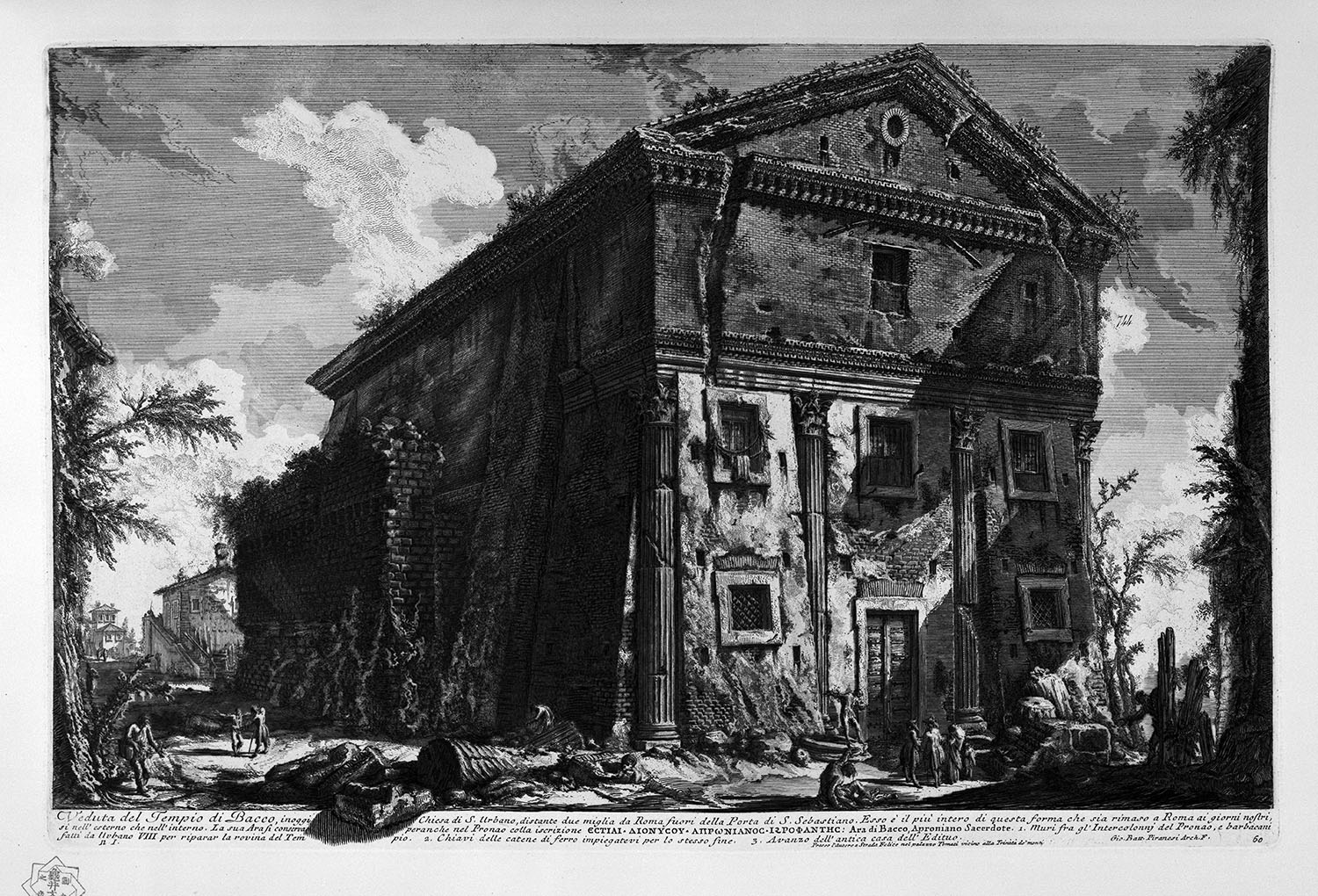
The temple was built after AD 150 at the initiative of Herodes Atticus, a consul of Athenian origin, scholar and patron of the arts, who had married the Roman noblewoman Annia Regilla. The construction was probably connected with the commemoration of his wife after her death and was dedicated to Ceres and the deified Faustina, wife of the Emperor Antoninus Pius. The decorative programme appears to suggest an intention to associate the memory of Annia Regilla with that of Faustina, evoking for the deceased a destiny in the afterlife traditionally reserved for members of the imperial family.
At the beginning of the 11th century, the building underwent an important decorative renovation. Much of the original architecture and ancient stucco work was preserved, while the walls were covered with an elaborate cycle of paintings, dating to the 11th century and traditionally associated with an inscription commemorating the renovation in 1011.
The building was subsequently abandoned and gradually fell into disrepair during the Late Middle Ages. In 1320, the anonymous author of the so-called Turin Catalogue recorded succinctly: “Ecclesia S. Urbani, non habet servitorem”, meaning “The church of Sant’Urbano has no custodian.”
A new restoration took place in 1634. On that occasion, the small bell tower and a new altar were built, while the medieval paintings underwent extensive restoration. Fortunately, a record of their original appearance has also been preserved through two series of watercolour copies commissioned by Cardinal Francesco Barberini, now kept in the Vatican Apostolic Library. The paintings in the crypt, by contrast, appear not to have undergone significant later alterations.
Originally, all four interior walls were entirely covered with paintings. The cycle was arranged in two superimposed registers. Only fragments of the lower register survive today. It probably consisted of a series of saints depicted frontally, following Byzantine artistic models.
The upper register, by contrast, still preserves thirty-four panels, divided into twenty scenes from the New Testament, four episodes relating to the martyrdom of Saint Lawrence and other saints, and ten scenes depicting the lives of Saint Urban and Saint Cecilia.
This last group of images is particularly significant, as it presents episodes from the lives of the two saints in narrative form. It is an important testimony to the development of Christian iconography in Rome: before this cycle, their stories had generally been represented through isolated images and portraits, such as those preserved in the Catacombs of San Callisto and in the mosaics of Santa Cecilia in Trastevere.
The cycle at Sant’Urbano alla Caffarella may therefore have played an important role in the development of the pictorial tradition devoted to these two saints. It is nevertheless difficult to establish with certainty whether this narrative form of their iconography originated here, as earlier examples in other medieval churches in Rome may have been lost.
LE DOMUS ROMANE DI PALAZZO VALENTINI
 55 min (7 km)
Via Foro Traiano, 84
From Hotel Columbia, walk to Termini Station (about 5–8 minutes).
Take Metro Line A towards Anagnina and get off at Colli Albani. From there, take bus 660 and get off at Appia Pignatelli / S. Urbano, close to the church.
By taxi: the journey from the hotel takes approximately 20–30 minutes, depending on traffic.
Reservation required by calling 060608 (daily, 9:00 a.m.–7:00 p.m.).