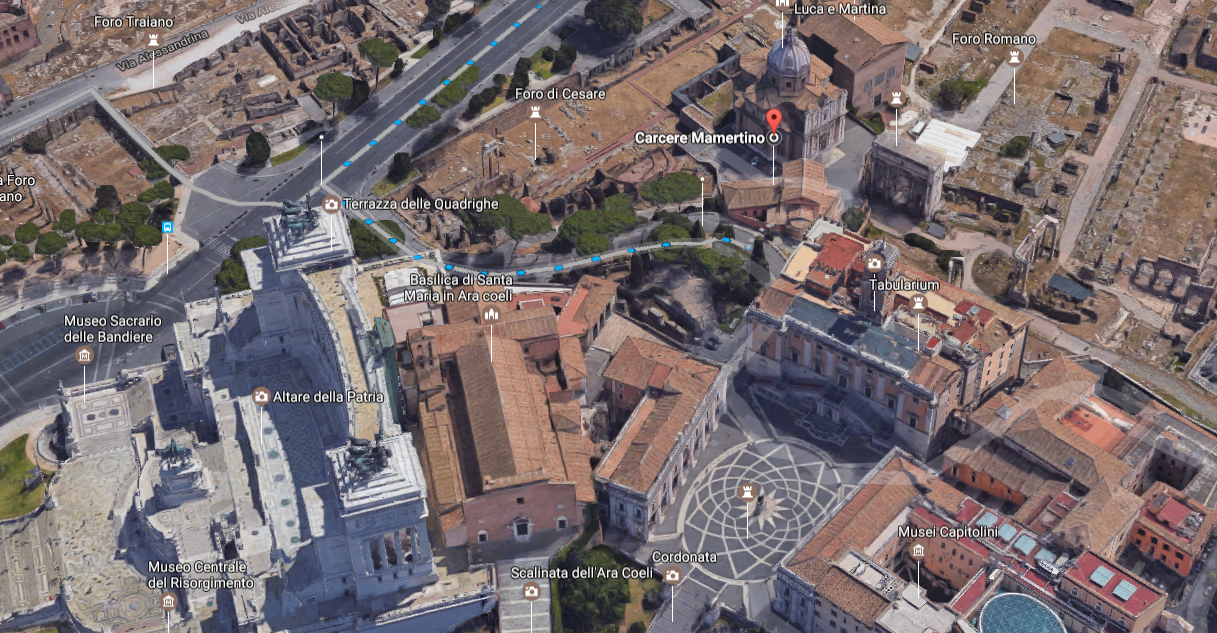

01 Sep Mamertine Prison – Carcer Tullianum


The Mamertine Prison, known in antiquity as the Tullianum, is one of the most important and fascinating monuments of ancient Rome. With a history spanning more than 3,000 years, it is a site of extraordinary historical and archaeological significance. The earliest evidence of human activity at the site dates back to the 9th century BC.
Located beneath the Church of St Joseph of the Carpenters, built in the 16th century, the prison overlooks the Roman Forum, offering one of the most impressive views of the city. The complex consists of two distinct levels: the Carcer, the upper level, traditionally dated to the 7th century BC, and the Tullianum, the lower level, whose origins are traditionally placed in the 6th century BC.
According to ancient sources, the Tullianum was used as a place of imprisonment and execution for enemies of the Roman state, including several prominent historical figures, such as Vercingetorix, the king and military leader of the Gauls who was defeated by Julius Caesar.
The Tullianum is also associated with an ancient Christian tradition concerning St Peter, the first of the Apostles. According to tradition, while imprisoned here, Peter struck the rock with his staff, causing a spring of water to miraculously emerge. He is said to have used the water to baptize his fellow prisoners and their guards. Over the centuries, the complex consequently became an important place of Christian devotion and remains a significant destination for pilgrims visiting Rome.
The visit to this exceptional archaeological site is enhanced by a multimedia experience, including videos and interactive tablets. Visitors can explore reconstructions of the original environments and discover further information about the archaeological remains and finds brought to light during recent excavations.
The Carcer Tullianum is managed by the Opera Romana Pellegrinaggi.
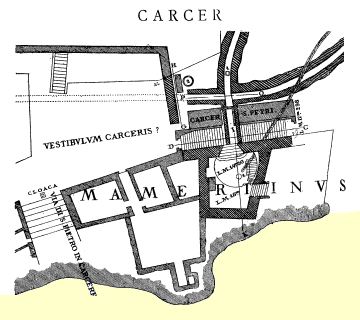
PIANTA DEL CARCERE
Il Foro Romano – Storia e Monumenti da Christian Hülsen, pubblicato da Ermanno Loescher & Co Editori di S. M. la Regina d’ Italia, 1905
Imprisonment was not a formal punishment under Roman statutory law, although detention is mentioned in the Twelve Tables and throughout the Digest. The concept of detention, however, included debt bondage in the early Republic, the use of chains (vincula publica), mainly for slaves, and, during the Imperial period, sentences involving forced labour, such as work in mills, mines, or quarries. Slaves and lower-status citizens sentenced to hard labour were often held in prison camps.
Incarceration (publica custodia) in facilities such as the Tullianum was generally intended as a temporary measure before trial or execution. Although abuses of this principle occurred, they were officially condemned.
Located near the law courts, the Tullianum served as a jail or holding facility for short periods before execution and, in some cases, as a place of execution itself.
In 63 BC, several of Catiline’s co-conspirators, including Publius Cornelius Lentulus Sura, were briefly detained in the Tullianum and executed there after being accused of conspiring to overthrow the Roman government.
In this case, the executions were carried out hastily and without the normal right of appeal, during Cicero’s consulship. Cicero was later exiled, in part as a consequence of his role in the executions. Sejanus was also held in the Tullianum before his brutal execution, which was followed by the mutilation and public display of his body on the Gemonian Stairs. Conflicting accounts of the fate of Pleminius include the possibility that he died in prison while awaiting trial. Some supporters of the Gracchi also ended up in the Carcer; among them was the unfortunate haruspex Herennius Siculus, who struck his head against an architrave and died before he could be executed.
There is no evidence that the Tullianum was used for long-term imprisonment, and the lowest chamber was particularly unsuitable for such a purpose. The level above, however, may theoretically have been used for longer detention. In general, long-term imprisonment became more common during the later Roman Empire. From the 4th century onward, under Christian emperors, Roman legislation and occasional personal interventions by emperors reveal an increasing concern with abuses such as unsanitary conditions and torture.
In some cases, it is unclear whether a source using the word carcer is referring specifically to the Carcer in Rome or simply to imprisonment in another facility.
High-status prisoners, whether Roman or foreign, were typically placed in the custody of individual Romans, sometimes in private residences or country estates.
The distinction between a prisoner of war and a hostage held under the terms of a treaty could be narrow, and conditions of captivity varied greatly, ranging from extreme hardship and humiliation to relative comfort and even luxury.
As a prisoner of war, Perseus of Macedon was confined in a foul and overcrowded dungeon at Alba Fucens, while the son of Tigranes was kept in the house of a Roman praetor, where he could even be presented as a guest at dinner parties.
The Tullianum played only a limited role in such detentions.
Captured foreign rulers and generals were paraded in the triumphal processions of Roman commanders. On a few occasions, some of the most prominent, notorious, or despised captives were subsequently executed at the Tullianum.
Such cases were relatively few and included the Samnite Gaius Pontius, the Gaul Vercingetorix, several Cilician pirates, and the Galatian ruler Adiatorix. Jugurtha, king of Numidia, may have been executed at the conclusion of Marius’s triumph, although another tradition holds that he died in prison several days later.
Most high-status prisoners of war were neither executed nor held for any substantial period in the Tullianum.
From Wikipedia
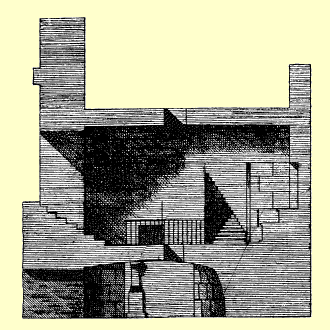
SPACCATO DEL CARCERE E DEL TULLIANUM
Il Foro Romano – Storia e Monumenti da Christian Hülsen, pubblicato da Ermanno Loescher & Co Editori di S. M. la Regina d’ Italia, 1905
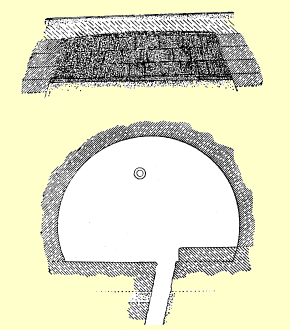
SPACCATO E PIANTA DEL TULLIANUM
Il Foro Romano – Storia e Monumenti da Christian Hülsen, pubblicato da Ermanno Loescher & Co Editori di S. M. la Regina d’ Italia, 1905
CARCER TULLIANUM
 21 min (1,6 km)
Clivo Argentario, 1
+39 06 699 24 652
Monday – Sunday