


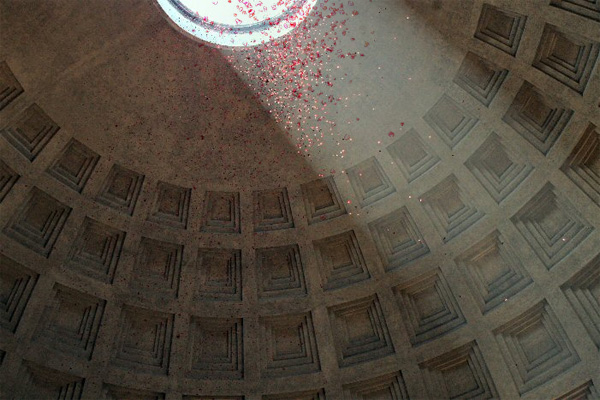
24 Sep The Rose Petal Shower at the Pantheon


PANTHEON
 17 min (BUS 40/64/70 from Via Nazionale to Largo di Torre Argentina)
Piazza della Rotonda
PENTECOST AND THE SHOWER OF PETALS
Pentecost Sunday – Mass at 10:30 a.m.
At the beginning of the 7th century, the Pantheon was converted into a Christian basilica, known as Santa Maria della Rotonda or Santa Maria ad Martyres. Appropriate attire is recommended for visitors.
On Pentecost Sunday, at the end of Mass, a shower of red rose petals falls through the oculus of the Pantheon onto the worshippers gathered inside the basilica.
Pentecost, celebrated fifty days after Easter, is the Christian feast commemorating the descent of the Holy Spirit upon Mary and the Apostles gathered in the Upper Room. According to the account in the Acts of the Apostles, the Holy Spirit manifested itself through a powerful wind and “tongues as of fire” that came to rest upon each of those present, marking the beginning of the Church’s mission.
At the end of the service, firefighters climb to the top of the Pantheon’s dome, more than 40 metres above the ground, and release thousands of red rose petals through the oculus, the large circular opening approximately 9 metres in diameter, allowing them to fall onto the worshippers below. The light entering through this “eye of the sky” accompanies the spectacular shower of petals inside the great rotunda.
The ceremony, which had been suspended for several years, was revived in 1995 and is now one of the most evocative events of the Roman Pentecost celebrations.
The symbolism of the rose is closely associated with Pentecost and the Holy Spirit: red evokes the fire of the Spirit and, in Christian tradition, also the blood shed by Christ for the redemption of humanity. The shower of petals therefore provides a visual evocation of the descent of the Holy Spirit upon the disciples, recalling the image of the tongues of fire described in the Acts of the Apostles.
These should not, however, be regarded specifically as so-called “Marian roses”. In Christian symbolism, the rose is certainly an important attribute of the Virgin Mary, traditionally associated with purity, beauty and perfection; however, the symbolism of colour is not so rigid as to identify the red rose exclusively with the Holy Spirit and the white rose exclusively with the Virgin Mary.
Another evocative shower of petals takes place in Rome on 5 August, at the Basilica of Santa Maria Maggiore, during the feast of Our Lady of the Snows. On this occasion, white rose petals are released to evoke the tradition according to which, on the night of 4–5 August 352, a miraculous snowfall indicated to Pope Liberius and a Roman couple, Giovanni and his wife, the site on the Esquiline Hill where the basilica was to be built.
Thus, in Rome, two major Christian celebrations are accompanied by two spectacular showers of petals: red at the Pantheon for Pentecost, evoking the fire and descent of the Holy Spirit; white at Santa Maria Maggiore on 5 August, recalling the miraculous snowfall associated with Our Lady of the Snows.